Martin Luther on the Creation Story in the Bible
Genesis 1 Creation Examined, part 6
6 Martin LutherOn Monday the 31st of March, 1535, Martin Luther held his final lecture on Psalm 90, and declared: "I will devote the remaining years of my life to an exposition of the books of Moses." On the next lecture he started explaining his views on Genesis.The text that we have was neither written by him nor strictly compiled from notes at those very lectures, but edited later by others, who allowed themselves some evident changes of Luther's lectures — but substantially the thoughts presented in the book are those of Martin Luther.
He agrees completely with Augustine, regarding the triple nature of God being the Father, the Son, and the Holy Spirit. To Luther, this is the obvious explanation to the plural being used for God, Elohim, and he repeats it frequently all through his text. He also sees the Trinity revealed in the three expressions used repeatedly during creation: "God said," "He made," and "He saw." The first is God begetting the Word, which is the Son who is thereby the maker by bestowing existence on things. The Holy Spirit approves the things created when seeing them.
Instead, he opposes firmly the somewhat symbolic interpretations that Augustine allows himself. To Luther, Genesis is written by Moses, and it is a straightforward account of how creation was orchestrated: "Moses spoke in the literal sense, not allegorically or figuratively," he determines. Those who have other views, Luther regards as childish or outright stupid. He finds plenty of them:
 Martin Luther, painting by Lucas Cranach the Elder, 1528.
Some other inconsistencies or questions of Genesis 1, Luther brushes off as futile because they simply cannot be understood by man. One such issue is what God might have been doing before the creation of time: "our mind cannot grasp what lies outside time."
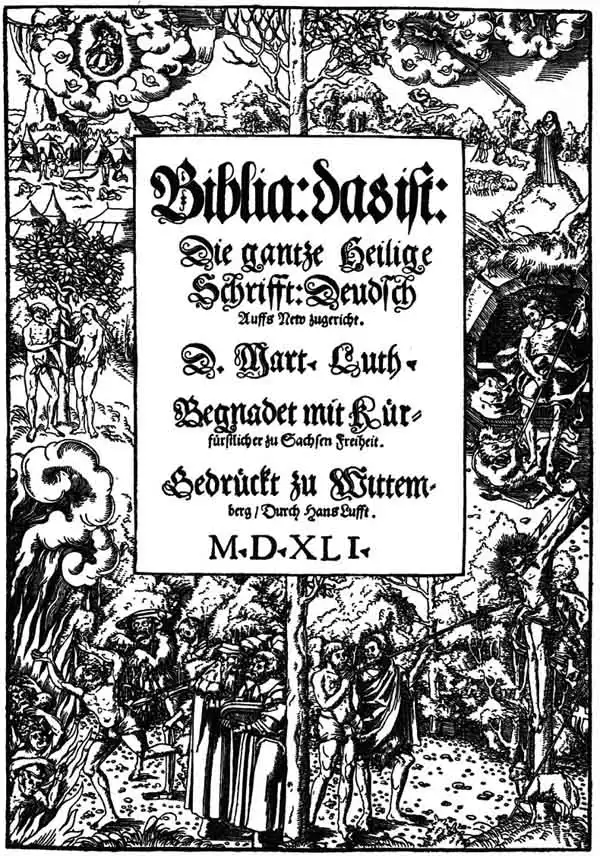 Frontispiece by Lucas Cranach the Younger of the 1541 edition of the Martin Luther Bible. The first edition of his complete Bible was published in 1534, but the New Testament already in 1522.
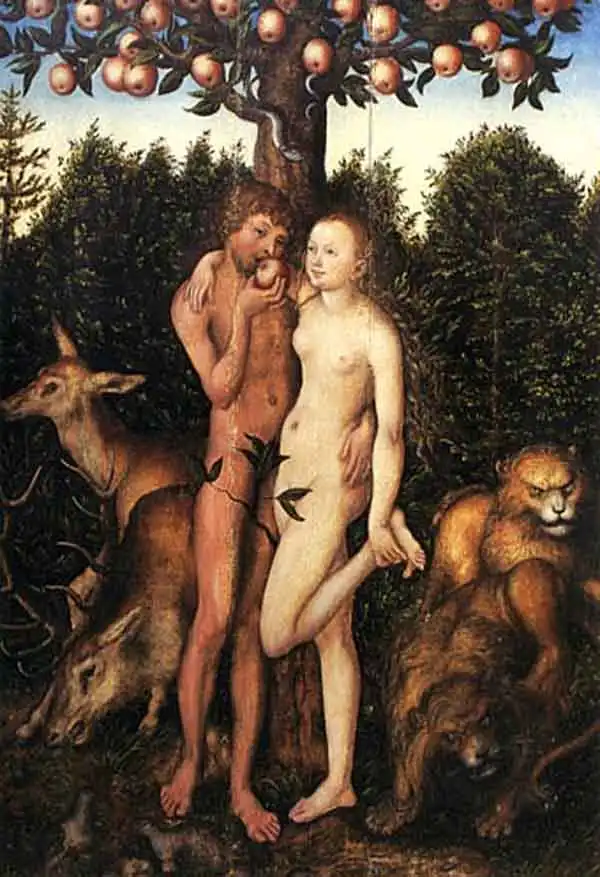 The Fall, by Lucas Cranach the Elder, c. 1530.
Luther regards the creation of the formless heaven and earth as having taken place the same day that later saw the creation of light, which immediately was put to such motion that it resulted in day and night. But it was not as "clear and brilliant" as later, when the sun was created to light the day. 7 Some conclusionsGenesis 1 CreationThe first creation of the Bible
This article was originally written for a seminar at the Department of History of Ideas and Learning, Lund University, as a part of my dissertation in progress on creation myths and their patterns of thought. Transforming the text to webpages, I have excluded footnotes, or edited them into the text.
MENUCreation Myths Around the WorldHow stories of the beginning began.
The Meanings of MythologyTheories through history about myth and fable.
Archetypes in MythsThe mythological symbols and what they stand for.
The Logics of MythPatterns of creation.
ContactAbout Cookies
CREATION MYTHS IN DEPTHCreation in Rig Veda 10:129The paradox of origin, according to an Indian myth.
Genesis 1The first creation story of the bible scrutinized.
Enuma ElishThe ancient Babylonian creation myth.
Xingu Creation of ManThe insoluble solitude of gods and humans.
ON MY OTHER WEBSITESPsychoanalysis of MythWhat Sigmund Freud and C. G. Jung thought about myths, their origins and meanings.
Myth of CreationAn introduction to the subject of creation myths and the patterns of thought they reveal.
Cosmos of the AncientsWhat the Greek philosophers believed about the cosmos, their religion and their gods.
Life EnergyThe many ancient and modern life force beliefs all over the world explained and compared.
TaoisticTaoism, the ancient Chinese philosophy of life explained. Also, the complete classic text Tao Te Ching online.
|
 Archetypes of Mythology
 Psychoanalysis of Mythology
 Cosmos of the Ancients
 Life Energy Encyclopedia
 Sunday Brunch with the World Maker
 Fake Lao Tzu Quotes
 Stefan Stenudd