Enuma Elish 2The Babylonian Creation Myth
2 The continued storyThe Enuma Elish story continues: Tiamat bears with the noise, but her spouse Apsu is aggravated and together with his vizier Mummu plots to kill the gods. The gods hear about it, and one of them, Ea (also called Nudimmud), kills Apsu and ties up Mummu. The verb ‘tie’ is the same as that for ‘conquer’. In the epic, both meanings of the word are used.
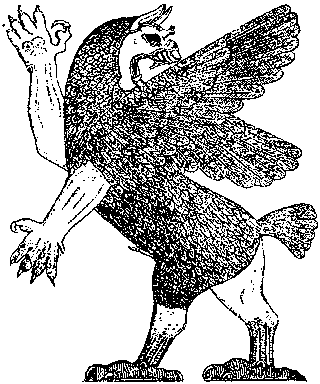
Marduk, Ea’s and Damkina’s son, is created within Apsu’s corpse. Marduk is given power over the winds, by which he makes a flood-wave that stirs up Tiamat. Some of the gods – unclear which ones – complain to Tiamat: Because they slew Apsu your lover and You did not go to his side but sat mute, He has created the four, fearful winds To stir up your belly on purpose, and we simply cannot sleep! They insist that she should do battle with the gods guilty of Apsu’s death and the continued unrest. The division of gods into those loyal or not to Tiamat may have been that of Anunna and Igigi, the two groups that the Babylonian gods were normally divided into. It is unclear what criteria was used for this division, and it might have changed through the times. Dalley has the Anunna connected to the underworld, and the Igigi to the sky. Tiamat is convinced by the complaining gods, and prepares for battle against “the gods inside him (Apsu).” Snakes with bodies filled of venom are created, and terrible dragons. The monsters are created by ‘Mother Hubur’, another name for Tiamat. All in all, she creates eleven kinds of monsters, of which nine are named: a horned serpent, a mushussu-dragon, a lahmu-hero, an ugallu-demon, a rabid dog, a scorpion man, aggressive umu-demons, a fish-man, and a bull-man. Dalley’s Enuma Elish version has eleven monsters in addition to the ones mentioned. Wikander’s Enuma Elish version has it to be eleven monsters, all in all. King’s Enuma Elish version implies eleven kinds of monsters, all in all, which is also how he expressly interprets it. If so, the snakes and dragons mentioned before the list of nine additional monsters must be included in the group of eleven. The Enuma Elish text is often translated so that it implies plural on some of the monsters, but it may very well point to singular. Tiamat also promotes her lover Qingu to head her army, and gives him the Tablet of Destinies. Qingu (previously spelled Kingu) is little known outside Enuma Elish. The meaning of the name is unknown.
Ea learns about this, and reports it to his grandfather Anshar, who blames him for it and demands of him to soothe Tiamat’s uprising. When Ea fails, his son Marduk volunteers to battle Tiamat and her monsters, but demands in return to be given supreme power over the gods: 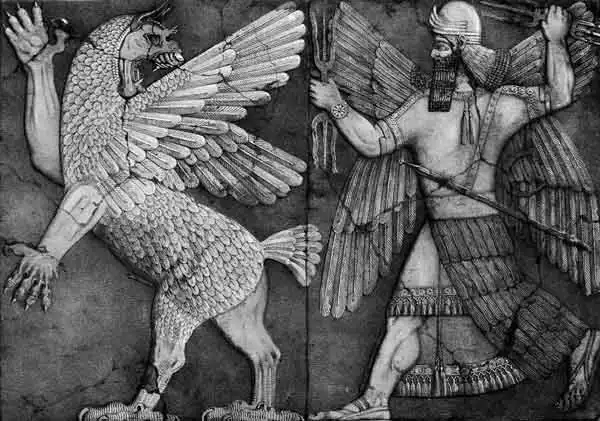 Marduk chases Tiamat. Marduk fixes the monsters with nose-ropes and ties their arms. He defeats Qingu and takes the Table of Destinies, seals it with his own seal and presses it to his breast. Out of Tiamat’s corpse, he creates the world: He sliced her in half like a fish for drying: Half of her he put up to roof the sky, Drew a bolt across and made a guard hold it. Her waters he arranged so that they could not escape. One wonders how her waters were arranged, not to escape. Perhaps an ordering of them into seas and rivers is implied. He also arranges the constellations in the sky, designates the year and the months, appointing three stars for each of the twelve months, and sets the moon’s phases. From parts of Tiamat he creates rivers and landscape. He makes “a house to be a luxurious dwelling for myself,” a cult center that will also serve as a resting place for the gods. I hereby name it Babylon, home of the great gods. The word used in the Enuma Elish text is written phonetically, ba-ab-i-li, contrary to tradition, maybe to allow for the etymological explanation of the name as the ‘gate of the gods’. Then Marduk decides to create man, to serve the gods with offerings, so that they can be at leisure. The word used in Enuma Elish for man is lullu, meaning a first, primitive man. The same word is used about the savage Enkidu in the Gilgamesh epic. Since Qingu is found guilty of the war between the gods, his blood is used to create mankind. Here, it is unclear if Marduk or Ea creates mankind. Later in the Enuma Elish text, Ea is specified as the creator of man. Finally, the gods praise Marduk, and give him fifty names that represent different aspects of his powers and sovereignty.
The Enuma Elish text ends with instructions on how it should be passed on from generation to generation, and the command to worship Marduk, king of the gods. 3 Enuma Elish: The SourceEnuma ElishThe Babylonian Creation Myth
This article about the Enuma Elish Babylonian Creation Myth was originally written in the year 2007 for a seminar at the Department of History of Ideas, Lund University, as a part of my dissertation in progress on Creation Myths and their patterns of thought. Transforming the text to webpages, I have excluded footnotes, or edited them into the text.
MENUCreation Myths Around the WorldHow stories of the beginning began.
The Meanings of MythologyTheories through history about myth and fable.
Archetypes in MythsThe mythological symbols and what they stand for.
The Logics of MythPatterns of creation.
CREATION MYTHS IN DEPTHCreation in Rig Veda 10:129The paradox of origin, according to an Indian myth.
Genesis 1The first creation story of the bible scrutinized.
Enuma ElishThe ancient Babylonian creation myth.
Xingu Creation of ManThe insoluble solitude of gods and humans.
ContactAbout Cookies
ON MY OTHER WEBSITESFreudian Theories on Myth and ReligionThe writings by Sigmund Freud and other Freudians on mythology and religion examined.
Jungian Theories on Myth and ReligionThe writings by Carl G. Jung and other Jungians on mythology and religion examined.
Myth of CreationAn introduction to the subject of creation myths and the patterns of thought they reveal.
Cosmos of the AncientsWhat the Greek philosophers believed about the cosmos, their religion and their gods.
Life EnergyThe many ancient and modern life force beliefs all over the world explained and compared.
TaoisticTaoism, the ancient Chinese philosophy of life explained. Also, the complete classic text Tao Te Ching online.
|
 Archetypes of Mythology
 Psychoanalysis of Mythology
 Cosmos of the Ancients
 Life Energy Encyclopedia
 Sunday Brunch with the World Maker
 Fake Lao Tzu Quotes
 Stefan Stenudd